

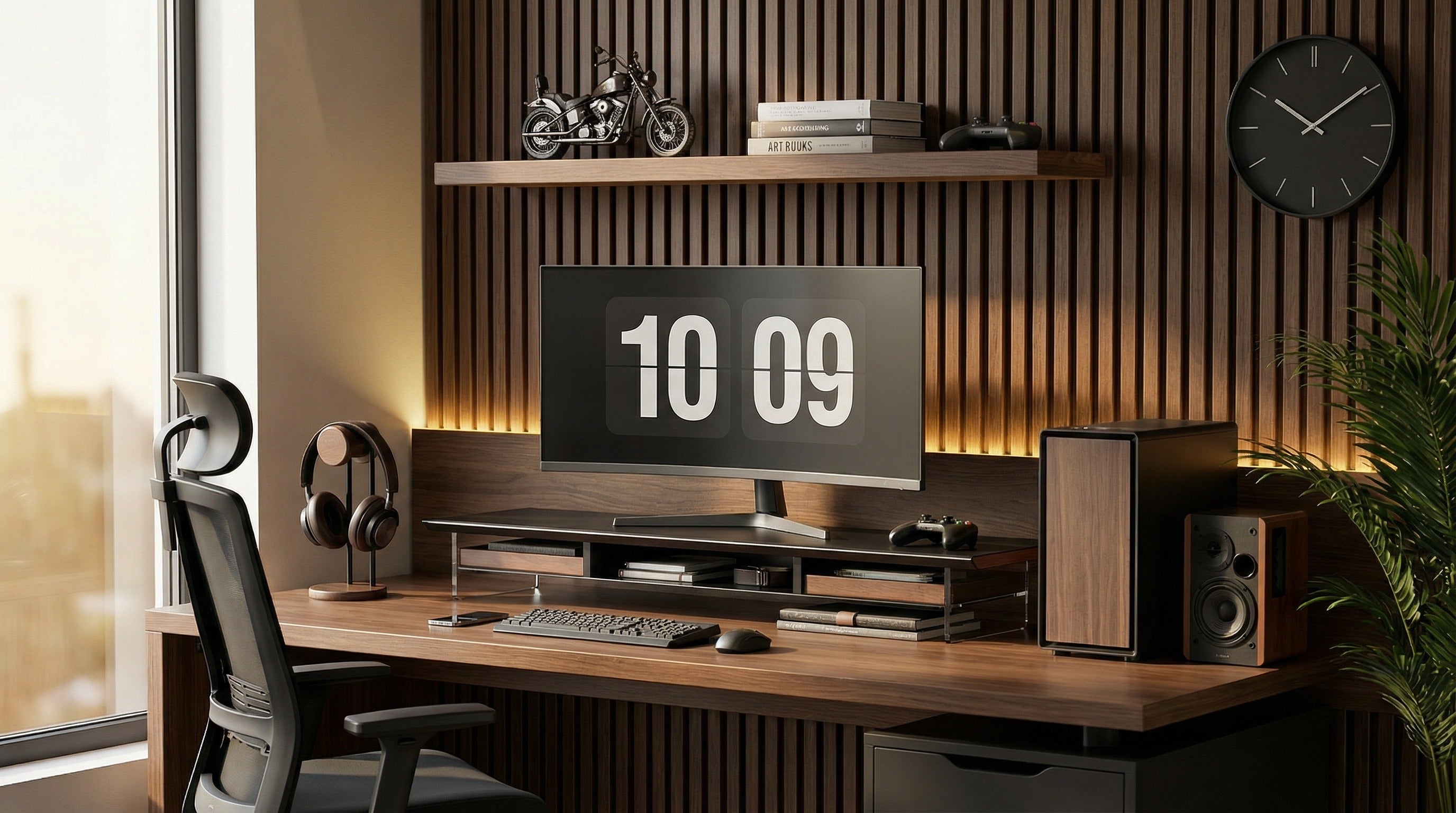
When you open the major social media platforms, you always see those enviable, perfect desks: wireless devices, minimalist layouts, and futuristic ambient lighting. But when you buy the same keyboard, mouse, or even decorative items, you find that your desk is still messy and your neck hurts after long hours of work.
That's not because you bought the wrong product, but because you lack systems thinking.
Building an efficient desk never means just piling up individual parts, but creating a desk system. For men striving for maximum efficiency, understanding modular workspace and productivity setup is the key to boosting concentration.
Why does "individual part thinking" slow down your efficiency?
The essence of individual part thinking is a fragmented solution. You get used to adding a new item for every pain point: a wrist rest for aching wrists, a shelf when space is tight. The result is that the desk becomes a "laboratory" of mismatched products. These disconnected items not only take up a lot of physical space but also subtly increase your "cognitive load."
Your gaze constantly has to shift between the low laptop and the high monitor; your hands have to search through a tangle of cables for a comfortable typing angle. Such a desk without systematic planning gradually drains your energy and drastically reduces your efficiency.
True efficiency is built on a seamlessly integrated system. Your desk should be like a precisely functioning machine, where every module serves ultimate productivity.

The 3 core elements of a "system-based desk"
The basic logic of a truly well-functioning desk system is based on the following three core dimensions:
Screen height: The optical anchor When working with focus, your gaze should be horizontal or slightly downward (about 15 degrees). However, the supplied stands of most monitors are far too low, forcing you to bend your head down for hours—the main cause of neck fatigue. System solution: Introduce a professional monitor riser. This is not just a physical elevation but establishes the "optical anchor" of the entire desk system and forces you into an upright sitting posture.
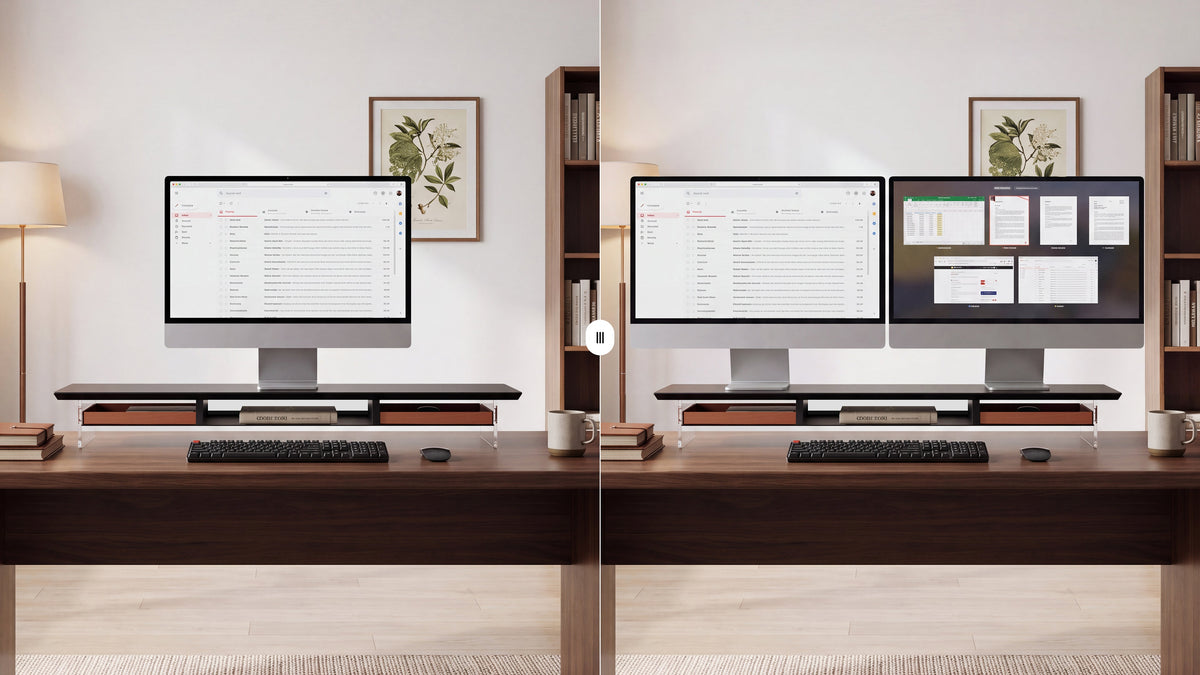
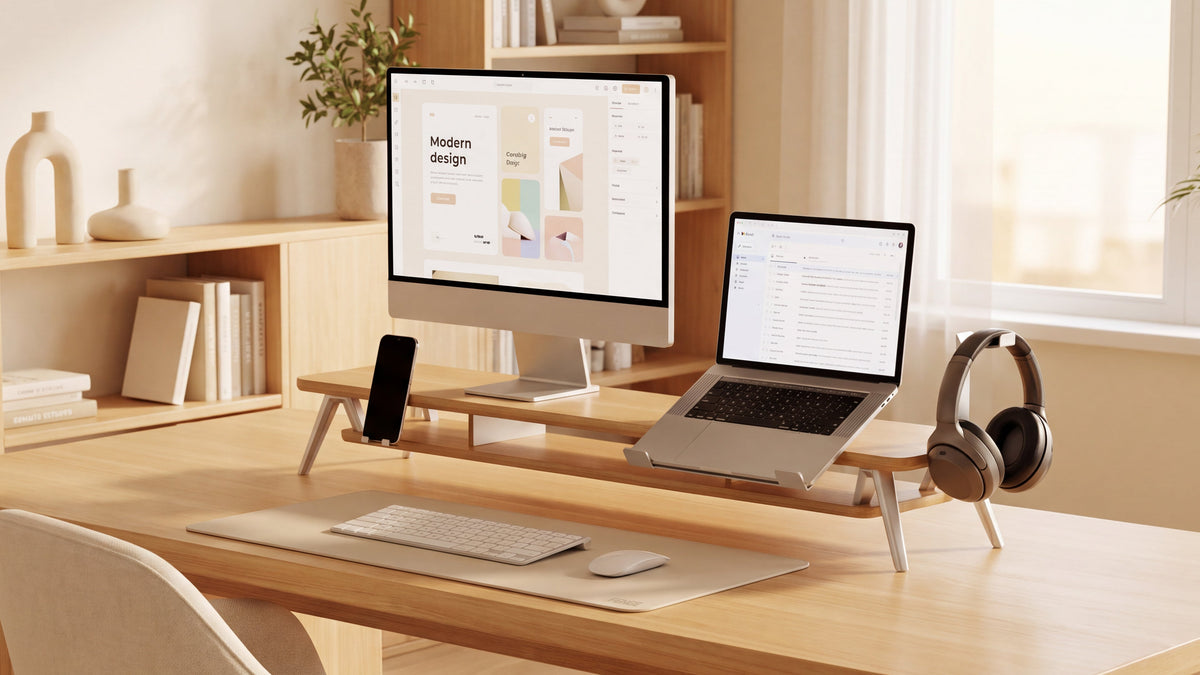
Supporting structure: The three-dimensional spatial layout The flat desk surface is limited. The secret of a system-based desk lies in "gaining efficiency from vertical space." System solution: Use a monitor riser to create space on the "Z-axis." The top holds the monitor and screen light, while underneath naturally forms a kind of "garage" to store the keyboard, mouse, docking station, or small items. This modular structure instantly transforms your desk from 2D to 3D.
Movement flow: The smoothness of muscle memory The path of your hand from the keyboard to the mouse and then to the smartphone or coffee cup should happen without thinking. If cables are in the way or items are too far away, this flow is disrupted. System solution: Place the most frequently used devices (keyboard, mouse) in the central work area directly in front of you; secondary devices (phone holder, water glass) go into the secondary area, easily reachable with your arm.

How to build your FENGE desk system step by step?
Building a system doesn’t require a complete restart; you can perform this modular upgrade in 3 steps:
The Reset: Clear everything off the desk until only the tabletop remains. Remove those "pseudo-productivity tools" you haven’t touched in a month.
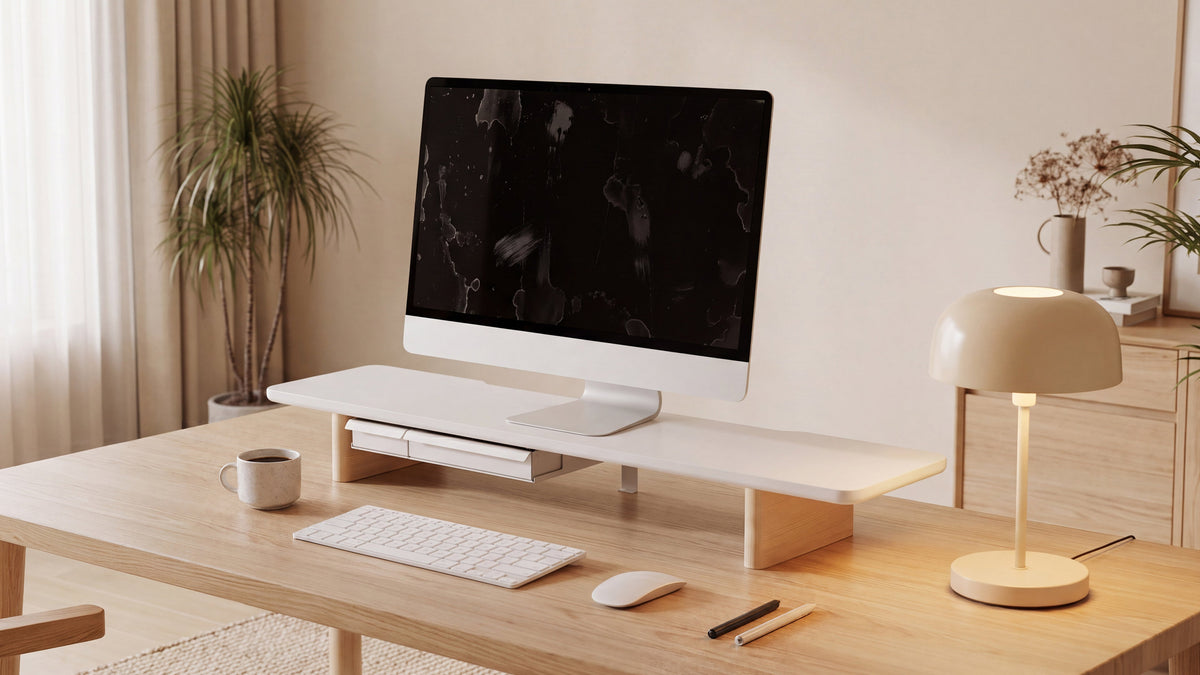
The Foundation: Place your FENGE monitor riser and set your main screen on it. Adjust the height so your spine is relaxed and your gaze is natural. This step determines the health factors and spatial layout of your desk.
The Modules: Put the keyboard and mouse back in place. Hide the "visual noise" like charging cables and docking stations under or behind the riser. Finally, add a screen light or ambient lighting as the finishing touch.
One Desk, One System. Your workspace is the visual expression of your mindset. Say goodbye to piling up individual parts and start by choosing a high-quality FENGE monitor riser to build a highly efficient work system that truly belongs to you.
Share:
Craftsmanship & Aesthetics: Why Texture Matters for Men
Start with Structure: The Bastion D510 Monitor Stand